 By
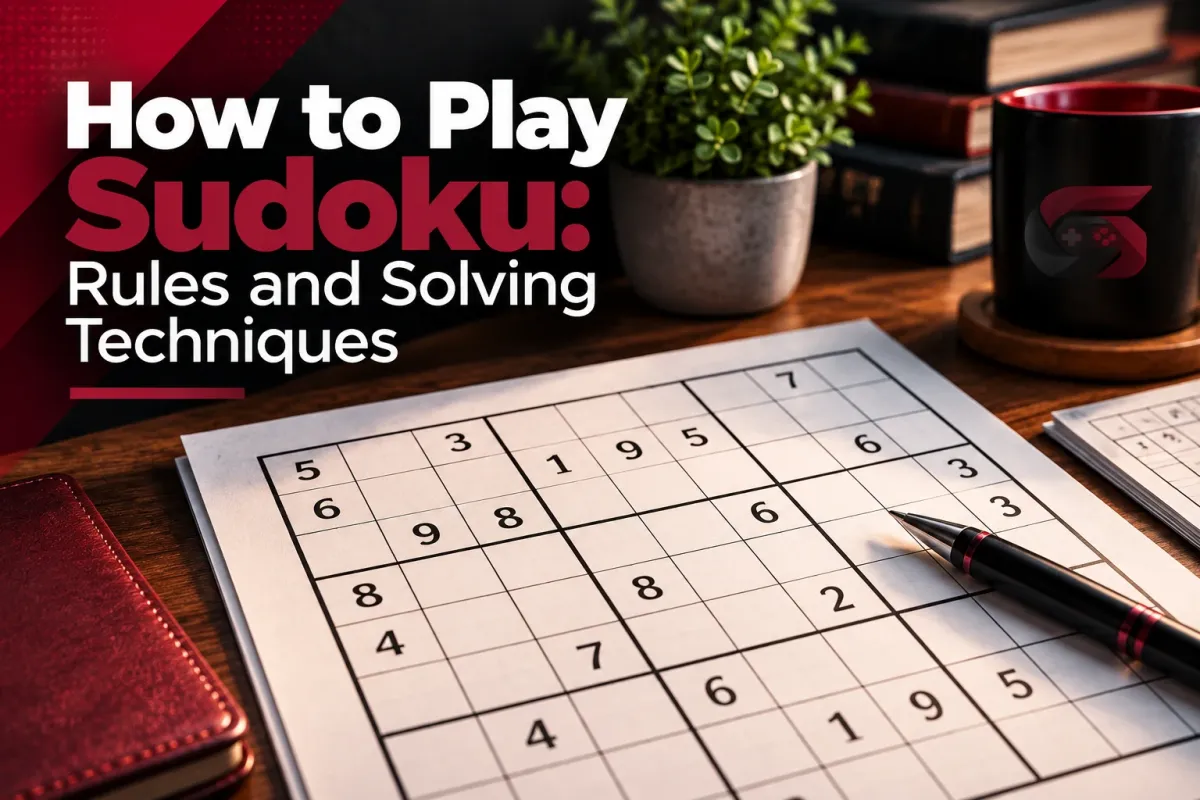
Sudoku is a number puzzle played on a 9 × 9 grid divided into nine 3 × 3 boxes. The rule is simple: fill every empty cell with a digit from 1 to 9 so that each row, each column and each 3 × 3 box contains every digit exactly once. No maths is needed; the numbers could just as well be letters or colors.
What are the parts of a sudoku grid called?
| Term | Meaning |
|---|---|
| Cell | One of the 81 small squares |
| Row | 9 cells across |
| Column | 9 cells down |
| Box | One of the nine 3 × 3 squares |
| Given | A number printed at the start, which you cannot change |
| Candidate | A digit that could still go in a cell |
A well-made sudoku has exactly one solution, which means you never need to guess. Mathematicians proved in 2012 that a puzzle needs at least 17 givens to have a single solution.
Technique 1: Scanning
Pick a digit, for example 5. Look at a box with no 5 in it. Every 5 already in the rows and columns that pass through that box rules out the cells in its line. If only one cell in the box is left, the 5 goes there. Repeat for each digit and each box. Easy puzzles can be solved with scanning alone.
Technique 2: Naked single
Look at one empty cell and list every digit already in its row, column and box. If eight different digits are there, the ninth is the answer.
Technique 3: Hidden single
Look at one row, column or box. If a digit can go in only one of its empty cells, it must go there, even if that cell has other candidates too.
Technique 4: Pencil marks
On harder puzzles, write the possible candidates in small numbers in each empty cell. Most sudoku games have a pencil or notes button for this. Every time you place a digit, remove it from the notes of the cells in the same row, column and box. Notes turn hard puzzles into a series of small eliminations.
Technique 5: Naked pairs
If two cells in the same row, column or box both have only the same two candidates, for example {3, 8}, those two digits must go in those two cells. You can remove 3 and 8 from every other cell in that row, column or box. The same idea works with three cells and three digits.
A quick worked example
Imagine row 1 is missing only the digits 2, 6 and 9, in the first three cells. Column 1 already contains a 6 and a 9 further down. That leaves only 2 for the first cell of row 1. Column 2 already contains a 9, so the second cell must be 6, and the third cell gets the 9. Three cells solved by checking one row against two columns.
What are the most common sudoku mistakes?
- Guessing. A guess that seems to work can break the puzzle 20 moves later. If you are stuck, look for a hidden single instead.
- Not updating notes. One stale candidate is a common reason a "correct" grid ends with a conflict.
- Only scanning rows. Boxes are often where the next move is hiding.
Where to practice
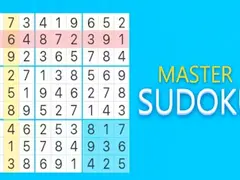
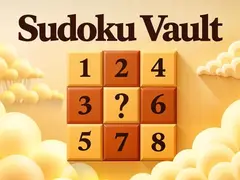
Master Sudoku is the classic 9 × 9 grid, with a pencil mode for notes. Sudoku Vault includes smaller 4 × 4 and 6 × 6 boards, which are a gentle way to learn, and Ultimate Sudoku has increasing difficulty levels. All of them run in your browser for free. For a bigger challenge, the World Puzzle Federation has supervised a yearly World Sudoku Championship since 2006.
Frequently asked questions
Do you need to be good at math to play sudoku?
No. Sudoku uses the digits 1 to 9 only as symbols, and solving it never involves adding or multiplying. The puzzle is about logic: placing each digit exactly once in every row, column and 3 × 3 box. The same puzzle would work just as well with letters or colors.
What is the minimum number of clues a sudoku can have?
A standard 9 × 9 sudoku needs at least 17 given numbers to have a single solution. Mathematicians proved this in 2012 with an exhaustive computer search that found no valid puzzle with only 16 clues.
Does every sudoku have only one solution?
A well-made sudoku has exactly one solution, so it can be solved by logic alone without guessing. Poorly made puzzles, or grids with too few givens, can allow more than one valid answer, and then at some point you would have to guess.
How do you solve a hard sudoku without guessing?
Start by writing pencil marks, the possible candidates, in every empty cell. Then look for hidden singles, where a digit fits only one cell in a row, column or box, and naked pairs, where two cells share the same two candidates. Remove candidates after every placement to keep the notes accurate.